Roses at 25°C: observations after five days
Frectro’s comparison of original packaging and fresh-control bags for Yunnan roses, with day-five photographs and company-reported mass-loss results.
Source version is the date of the archived Chinese file, not a verified original publication date.
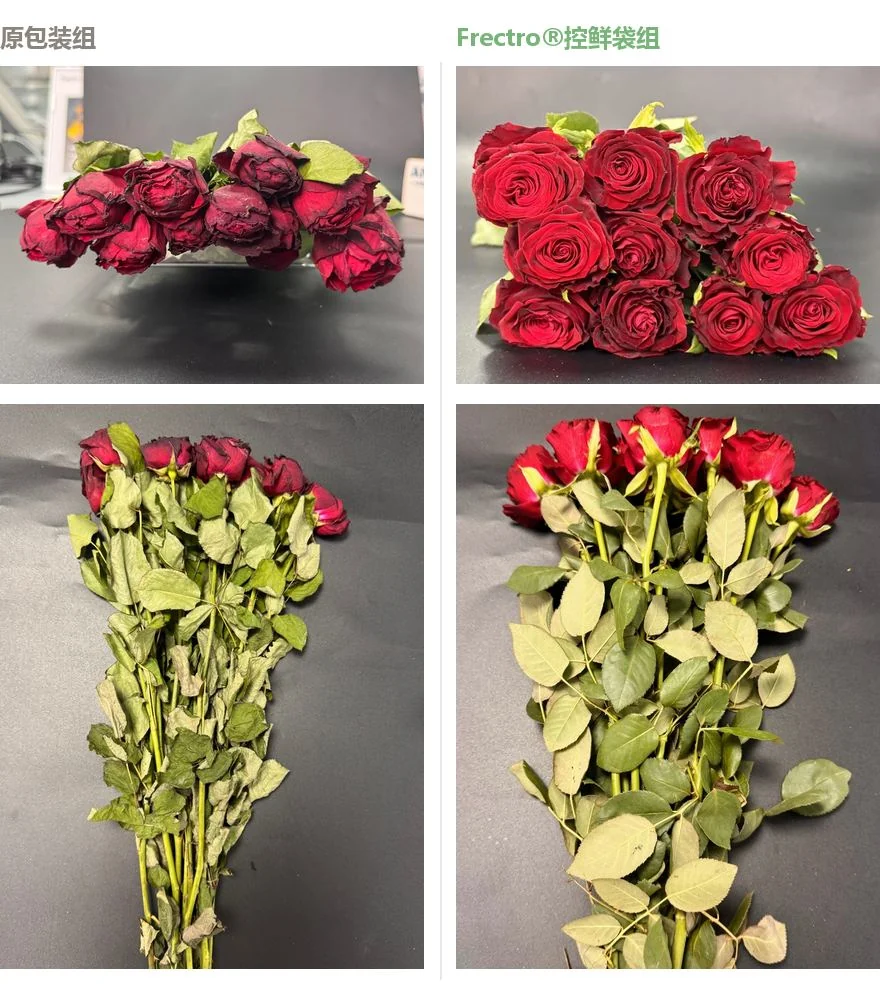
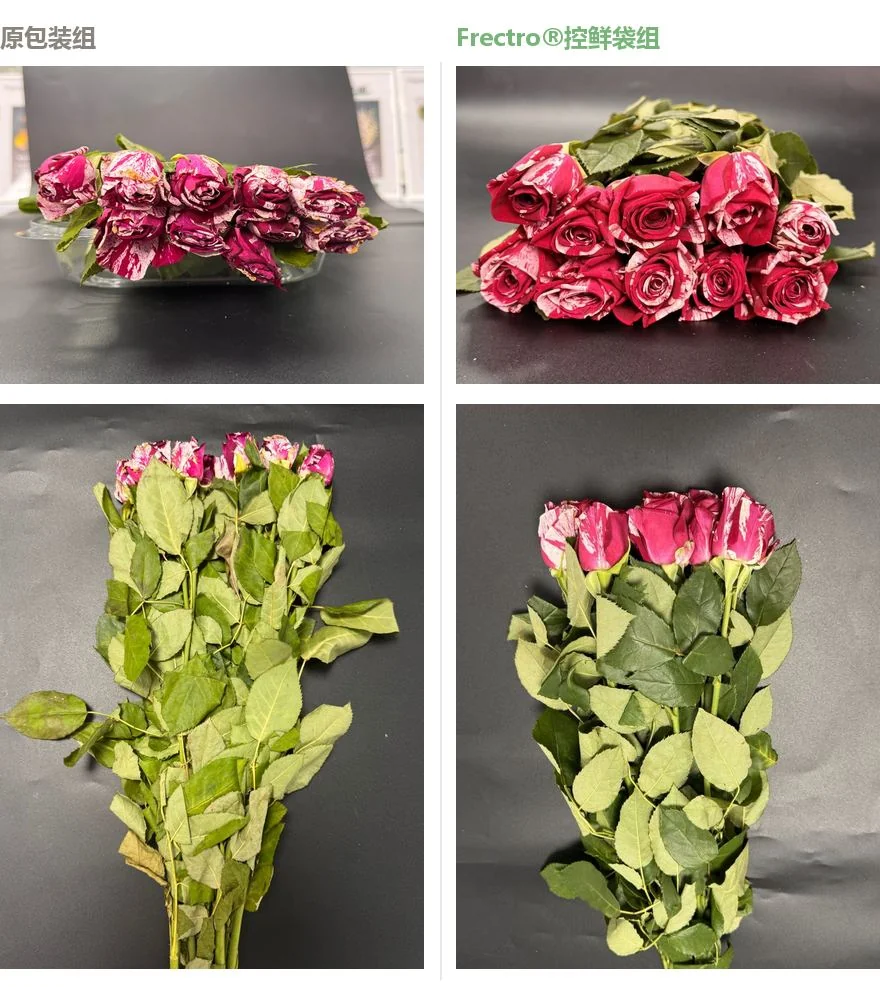
What happens to cut roses during a warm holding period? Frectro’s flower trial article describes a comparison between the customer’s original packaging and a fresh-control bag, using roses from Yunnan held at around 25°C and opened for inspection on day five.
The company’s photographs show the two packaging groups side by side. Its written record reports differences in petal and foliage condition as well as mass loss. For flower wholesalers and importers, the useful starting point is the test configuration: which flowers were packed, under what conditions, and what was measured when the bags were opened.
The conditions behind the comparison
According to Frectro’s account, the customer wanted to examine a period without cold-room storage. Roses from the same batch were divided between the original packaging and Frectro bags, kept in the same setting, and observed at the same time. The article includes red roses and a second pink-and-white flower set.
| Item | Reported condition |
|---|---|
| Flowers | Cut roses from Yunnan; same-batch comparison |
| Temperature | Room temperature, approximately 25°C |
| Inspection | Bags opened and groups compared on day five |
| Packaging groups | Customer’s original packaging and Frectro fresh-control bags |
What the day-five photographs show
The original-packaging groups show more curled petals and wilted foliage. The bagged groups have fuller-looking flower heads and more extended leaves. These are observations from the company’s photographs at opening; they do not measure the flowers’ remaining vase life.
The mass-loss figures in the written record
The source reports the following values for the two flower sets. It does not assign each number to a named cultivar or colour, so the values are reproduced together rather than mapped to a photograph.
| Packaging group | Values reported for the two sets |
|---|---|
| Original packaging | 26.47% and 37.58% |
| Frectro fresh-control bag | 0.89% and 1.92% |
These figures come from Frectro’s written trial account. The article does not include sample counts, individual starting weights or repeated-trial statistics. Request the underlying test record when evaluating a commercial specification.
What this means for flower handling
A packaging result should sit alongside a complete handling plan. UC Davis’s rose handling guidance recommends cold storage and discusses cultivar differences, water uptake and the risk of moisture collecting on petals. The warm holding conditions in this company trial should not be treated as a new storage recommendation.
Likewise, a useful result for these roses does not set a specification for every flower. Frectro’s source article describes application-specific calibration: the flower, loading, temperature and route need to be considered together. Packaging cannot reverse damage already present at packing.
Build a comparison around your own route
For a follow-up, record the cultivar, harvest stage, stem count, packing method, time out of cooling and expected receiving condition. Compare the proposed bag with the packaging used today under matched conditions. Assess both opening quality and subsequent vase performance, using the same receiving criteria for each group.
Explore the fresh-control bag format or share your flower handling brief to discuss a suitable comparison.
Your produce. Your route.
Put the next question to the test.
Tell us what you pack, where it travels and the quality you need at arrival. Start with a comparison using your current packaging.
Discuss a trial